
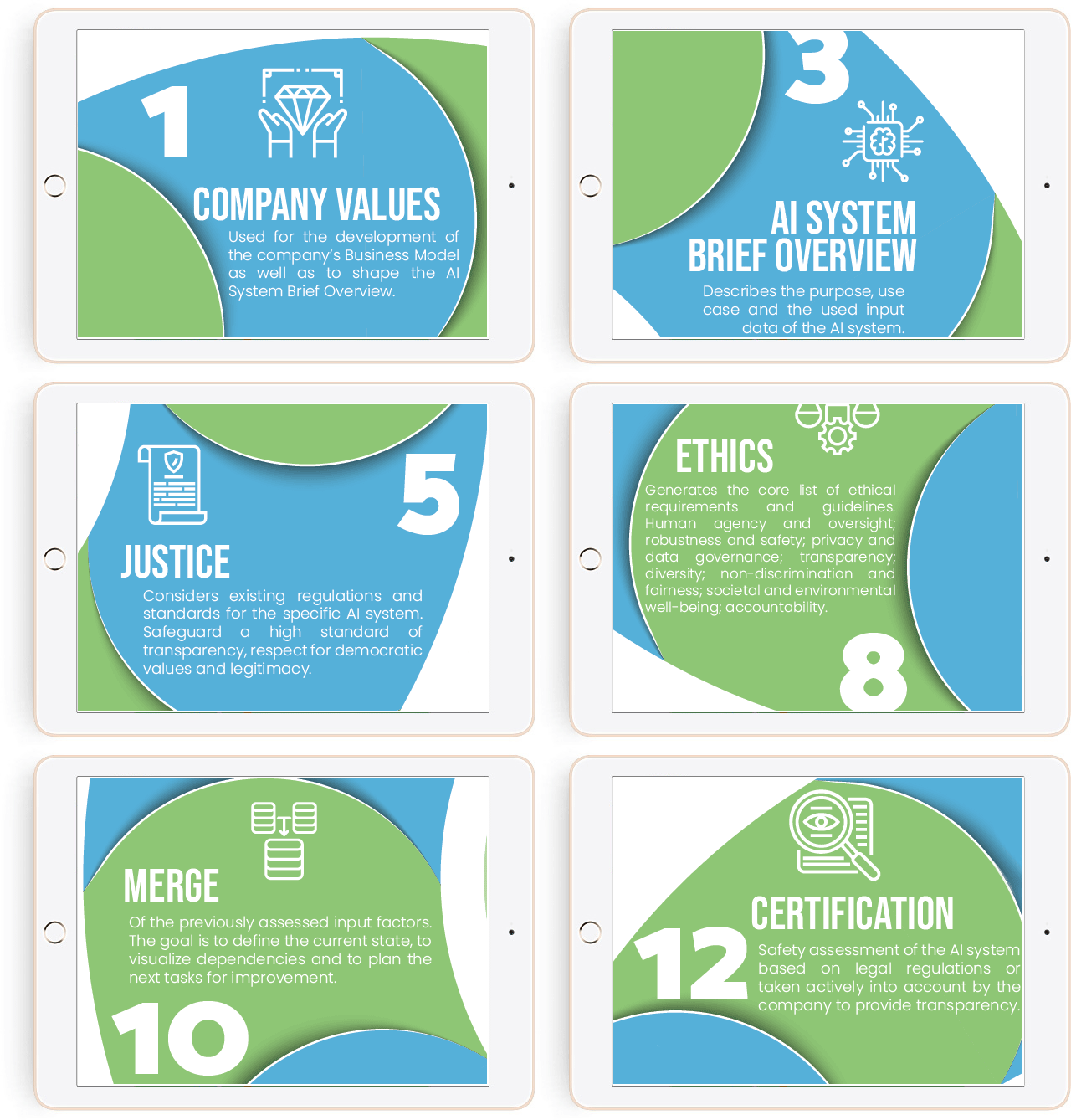
Trustworthy AI as a Services
We offer expert guidance on responsible AI development, ensuring your projects align with ethical standards and societal values.
Our Services
Create trust in your AI systems by implementing ethical principles and social impact to your offerings.
TAII Framework® Consulting
Customized for your business
Expert guidance on integrating trustworthy AI into your system development and business practices.
AI Business Model Innovation
Customized for your company
Comprehensive reviews of your AI systems to maximize your customer value under consideration of its social impact.
AI Literacy Workshop
Customized for your team
Workshops and training programs to educate your team on trustworthy AI and its social impact.
AI Governance
Industry specific approach
Assistance in creating AI governance policies aligned with ethical principles for your organization.
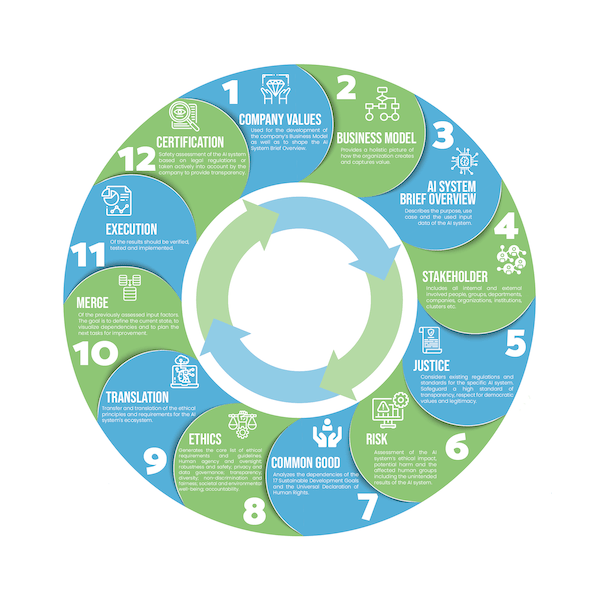
The TAII Framework ensures ethical consistency in AI system development through several key approaches:
- Holistic perspective: It analyzes systemic ethical relationships within the company ecosystem, considering corporate values, business models, and common goods aspects like the 17 Sustainable Development Goals and the Universal Declaration of Human Rights.
- Early-stage implementation: The TAII Framework is particularly effective when used in the early stages of AI system development, allowing for the incorporation of broader perspectives from stakeholders along the value chain.
- Stakeholder analyzis: The TAII Framework explores implications for the common good and analyzes affected stakeholders, including both technical and non-technical audiences.
- Ethical inconsistency detection: It provides management teams with practical guidance to initiate trustworthy AI implementation by analyzing ethical inconsistencies and dependencies for planned AI systems.
TAII Framework®
Organizations and companies need practical tools and guidelines to kick-off the implementation of Trustworthy Artificial Intelligence (TAI) Systems. The scientific research based Trustworthy Artificial Intelligence Implementation – TAII Framework takes a holistic approach to identify the systemic relationships of ethics for the company ecosystem and considers corporate values, business models, and common good aspects like the 17 Sustainable Development Goals and the Universal Declaration of Human Rights.
The TAII Framework Canvas creates guidance to initiate the implementation of AI ethics in organisations without requiring a deep background in philosophy and considers the social impacts outside of a software and data engineering setting. International organizations and universities do trust the TAII Framework. Contact us for a first step towards a trustworthy AI system development.


- Adaptability: It can be adapted and used with a range of regulations and ethical principles, depending on the specific legal context or area of application.
- Risk assessment: The TAII Framework supports companies in developing trustworthy AI systems within each risk level, as classified by regulatory frameworks like the EU AI Act.
- Accessibility: It decreases the entry-level barrier for AI ethics implementation, making it accessible to organizations without requiring deep philosophical background.
- Continuous improvement: The TAII Framework is iterative and refers to the whole AI system’s life cycle, allowing for ongoing refinement and improvement of ethical considerations.
AI Literacy Workshop
Strengthen your AI knowledge in accordance with Art. 4 of the EU AI Act, including responsible and trustworthy AI implementation. This applies to all companies that provide or deploy AI systems in the European Union (EU) since February 2025.
The workshop includes: What is AI ethics? Values and norms. Ethical frameworks. Common good & well-being. Utilitarianism. Accountability. Transparency. Human rights. Data privacy. Safety & Robustness. Bias. Fairness & Non-discrimination. Ethics-washing. Guidelines & Principles.
Book an AI ethics workshop to kick off AI ethics in your organization, including a certificate and exercises to proof compliance.
Download shareable resource.

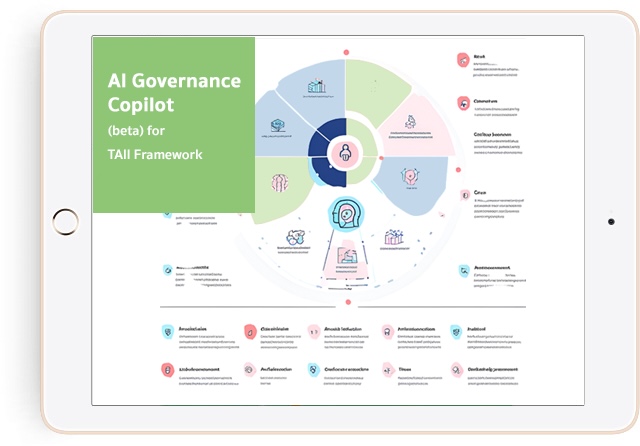
AI Governance
Trustworthy AI Implementation (TAII) supports different standards and regulations depending on risk evaluation, geographic market and industries. AI Governance helps organizations navigate the complexity and provides clarity on which standards and regulations to focus on. Contact us for consulting on special industry regulations.
AI Governance Standards and Regulations:
ISO/IEC 22989 Standardized AI Concepts & Terminology, ISO/IEC 23053 AI System Frameworks for ML, ISO/IEC 23894 AI Risk Assessment & Mitigation, ISO/IEC 24029 Neural Network Robustness, ISO/IEC 8000-2 Data Quality Fundamentals, ISO/IEC 25059 AI System Quality Model, ISO/IEC 5259 Data Quality for Analtics & ML, ISO/IEC 27001 AI Data Security, ISO/IEC 27701 Privacy in AI Systems, ISO/IEC 19944 AI Data Flow & Gov. in Cloud Platforms, ISO/IEC 42001 AI Mgmt. System, EU AI Act, GDPR, EU Data Act, EU DSA, EU DMA, NIST AI RMF 600-1, NIST SP 800-218A, NIST AI 100-4, NIST AI 100-5, etc.
AI Literacy by Law
To be compliant with Article 4 of the EU AI Act, companies need to take measures of increading AI literacy.
The following points are outcomes of using the TAII Framework for trustworthy AI system development. By taking these steps, companies can ensure they meet the AI literacy requirements set out in Article 4 of the EU AI Act.
Assessment of current AI literacy levels: Companies evaluate the existing AI literacy within their organisation, including the technical knowledge, experience, education, and training of their staff.
Implementation of training programs: Develop and provide regular training programs that cover both the technical aspects of AI and the ethical considerations. This training should be tailored to address the specific roles and responsibilities of employees.
Development of internal guidelines and standards: Establish clear guidelines and standards for AI use within the company. These should outline best practices, ethical principles, and compliance requirements.
Continuous improvement: The TAII Framework is iterative and refers to the whole AI system’s life cycle, allowing for ongoing refinement and improvement of ethical considerations.
Encouragement of interdisciplinary communication: Foster communication and collaboration between different departments such as IT, ethics, and legal. This helps in developing a comprehensive understanding of trustworthy AI systems.
Documentation of compliance efforts: Keep detailed records of all AI literacy measures implemented, including training programs, guidelines, and any other initiatives. This documentation will be crucial for demonstrating compliance during regulatory inquiries.
Stay updated with evolving standards: Regularly review updates from regulatory bodies and industry best practices to ensure ongoing compliance.
Embed AI literacy across the organisation: Ensure that AI literacy is not limited to technical teams but is integrated across all relevant aspects of the business.
 SocialTechLab.eu